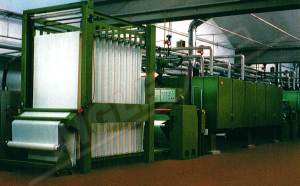
Transfer Coating Line – mod. LSPT
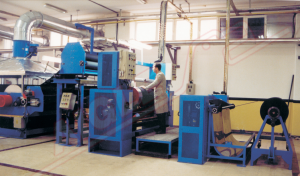
View Technical DetailsLSPT transfer coating line for synthetic leather: PVC and PU layers coated on release paper, dried, laminated to the fabric, with the paper rewound and reused.

AIGLE’s coating, laminating and flocking machines can be applied in the automotive and industrial components industry; for example: flocked rubber profiles, flocked glove compartments, carpets, coated seats, various flocked components, etc.
LSPT transfer coating line for synthetic leather: PVC and PU layers coated on release paper, dried, laminated to the fabric, with the paper rewound and reused.
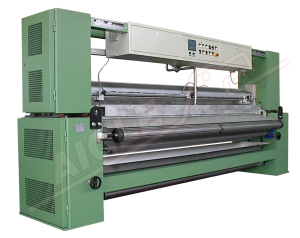
BSR/F coating machine for fabrics with resins and adhesives: air-coating or on cylinder, motorized thickness adjustment, at the inlet of a common stenter.
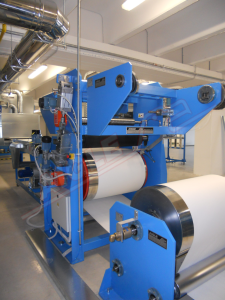
GRA/1 laminating group for wet and dry-coat lamination: chrome-plated laminating cylinder with micrometric adjustment and rubber cylinder, heated with oil or cooled with water.
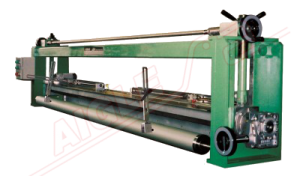
BS coating head for fabrics: a simple coating unit that can be placed at the inlet of a common stenter, taking up minimal space.
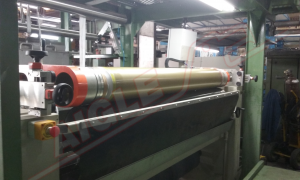
BS1 rotary screen coater to coat and print fabric with pigments, resins and adhesives and for pattern flocking, with pneumatic screen lifting.
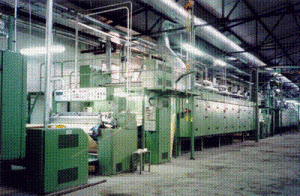
FOP/C drying oven for coating lines, in modular bays: recirculation fan, oil heat exchanger, blowing channels and filter, with opposed fields for uniform heating.
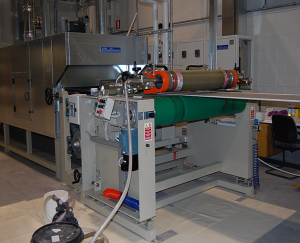
BS1/T rotary screen coater for coating and printing fabric with pigments, resins and adhesives and for pattern flocking, with doctor-blade paste feeding.
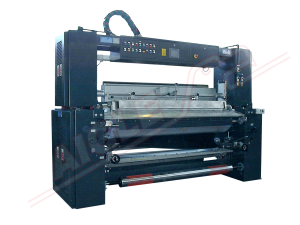
BSR/M coating machine for fabrics with resins and adhesives: air-coating, coating on cylinder and on photo-engraved cylinder, at the inlet of a stenter.
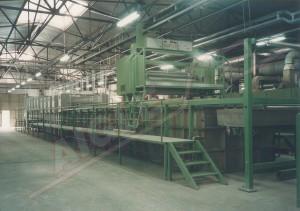
LC coagulation line for breathable synthetic leather and filters: a 40 m accumulator for roll changes without stopping and an Omega drawing unit for constant tension.
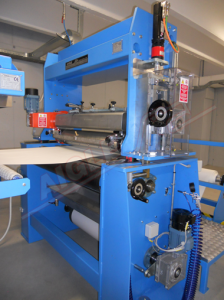
BSR/R coating machine for fabric, paper and non-woven with resins and adhesives, easy to install at the inlet of a stenter or oven.
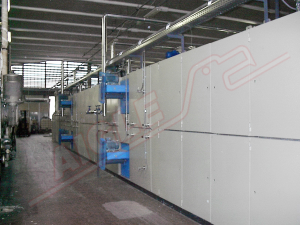
RAM/F stenter: circulation fan, oil heat exchanger, blowers, recovery channel and filter, with opposed right/left fields for uniform heating and air distribution.
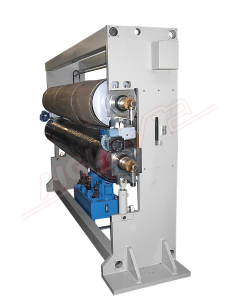
GG/IR calendering unit with hot or cold calendering roll: heavy-duty shoulders and counter roller covered with hard neoprene.
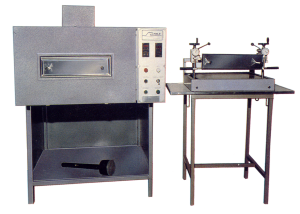
JP laboratory oven and direct coating head: electric oven with several heating modes, coating head with micrometric thickness adjustment and frames for fabric samples.
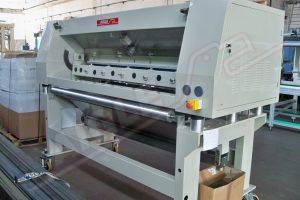
TDP/M powder distribution unit: hopper with inverter-controlled dosing cylinder, doctor blade and rotating brush; optional electrostatic unit for more uniform powder.
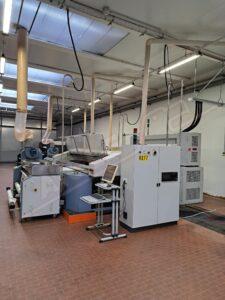
BSR/DIG coating head for fabric pre-treatment before digital printing: doctor-blade coating at the inlet of the printing line, with no stenter pre-treatment and higher print quality.
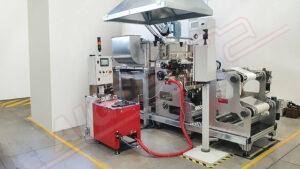
LC/F coagulation line for filters and synthetic leather: a wet process in which the substrate is impregnated or slot-coated and then coagulated in water with chemical compounds.

Pre-preg line: fibres spread and calendered between films, impregnated with thermosetting or thermoplastic resin, partially cured, protected with release films and rewound.
AT2 laminating line: BS2 coating head and lamination unit with two cylinders heated by diathermic oil, unwinding and rewinding of large rolls, optional dry-coat unit with calender.
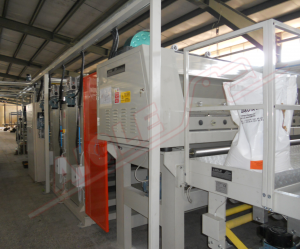
LAP powder scattering laminating line: TDP/M powder unit, FIR-S infrared panel and GRA/1 laminating unit, with precise powder distribution and constant fabric tension.
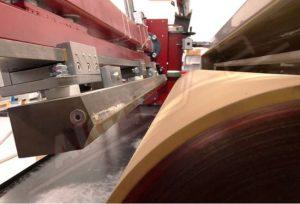
LHM hot melt lamination line with thermoplastic or reactive PUR adhesives: smooth cylinder, engraved cylinder for breathable dot lamination, or slot system from 2–3 to 500 g/m².
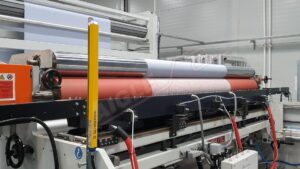
LHM 3L hot melt laminating line, developed with Bridarolli, that laminates three layers (e.g. fabric + membrane + fabric) in one pass, with very accurate tension control.
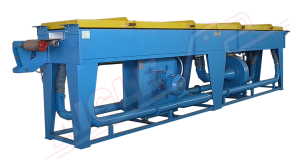
AFC forced air cooling unit for profile flocking lines: after the vulcanisation oven, it lowers the profile temperature before sanding and glue spraying.
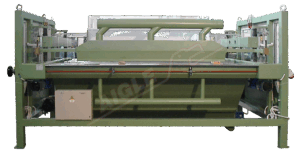
FR2 flocking machine for fabrics and roll materials: two electrostatic hoppers with multi-row rotating brushes, adjustable speed and pressure, beater bars and flock recovery.
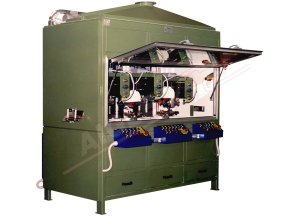
SUC3 and SUC2+1 sanding machines for the profile surfaces that receive the adhesive, for optimal adhesion especially on EPDM profiles.
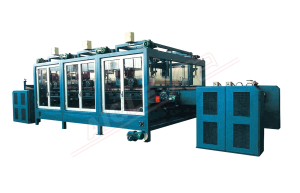
FR6 flocking machine for fabrics and roll materials: three modules with two electrostatic hoppers each, multi-row rotating brushes and a 0–100 kV generator.
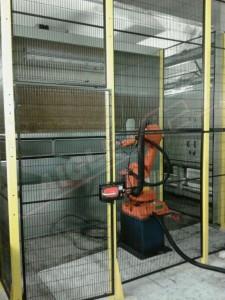
CV/R automatic glue spraying cabinet: closed cabin, double dry filtration with quick-change Paint-Stop cover and suction fan.

GE-100-1-CASE electrostatic generator for flocking: stabilized tension, constant whatever the operating conditions, and automatic anti-stalactite device.
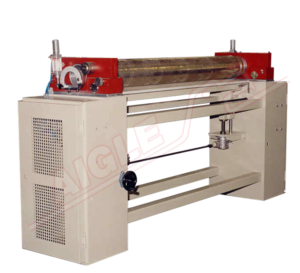
AP1 blowing/embossing machine for flocked fabric, placed between the flocking unit and the oven so that it embosses while the adhesive is still wet.
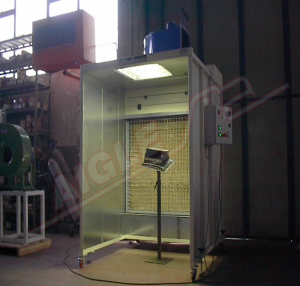
CV glue spraying cabinet, open at the front: double dry filtration with quick-change Paint-Stop cover and suction fan.
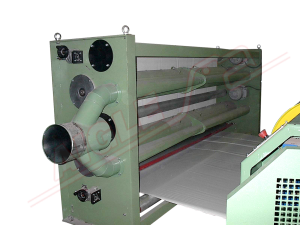
SZ2 brushing unit for flocked fabric: two rotating brushes with beater-bar effect and adjustable pressure, sealed in suction chambers to avoid flock dispersion.
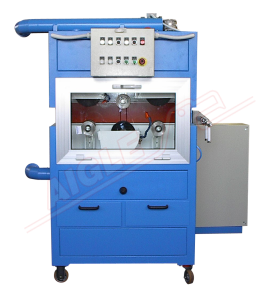
SZ3 brushing unit for profiles: it cleans sanding residue before glue application or flock residue after vulcanization; mounted on wheels.
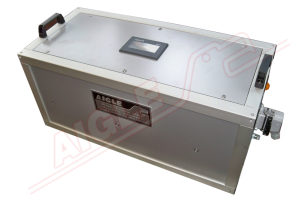
GE-100-2-CASE electrostatic generator for flocking: stabilized tension, automatic anti-stalactite device and PLC control of the SMT grounding system.
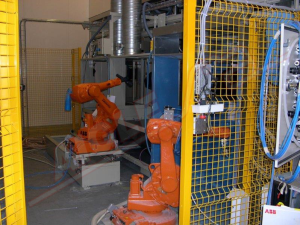
CA/R-ESP automatic flocking cabinet: closed safety cabin, electro-pneumatic ESP flocking gun, flock recovery system and suction fan.
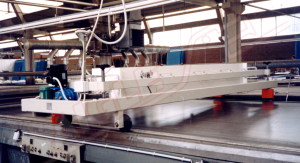
TCR/COMPL flocking trolley for flat screen printing machines: it runs on rails synchronized with the printer and flocks the fabric between printing phases.
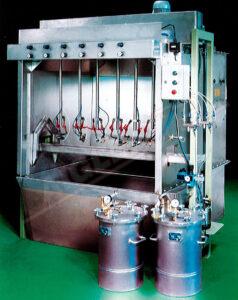
ADP6 adhesive application cabin, built entirely in stainless steel, with anti-spark exhausters that extract the adhesive fumes.
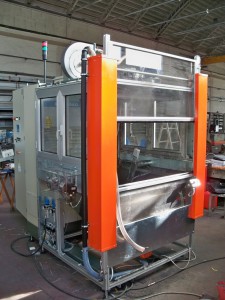
CA-ESP automatic cabinet for flocking 3D objects of many shapes: fully automatic flocking and pre-cleaning for the lowest flock excess.
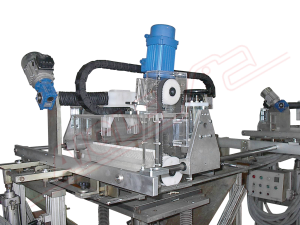
LFM multicolour flocking for flat screen printing lines: one flocking unit per colour on any station, synchronized with the printing machine, for sheets and continuous material.
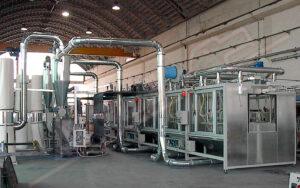
FAO automatic plant for flocking car glove compartments: step-by-step chain conveyor through modular flocking and pre-cleaning stations, for high productivity and fewer defects.
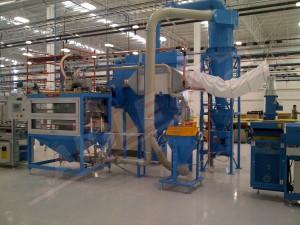
FR1/R profile flocking module: used alone, combined for higher speeds or with FR/ESP for undercuts; GE-100-3 generator, longitudinal hopper and flock recovery.
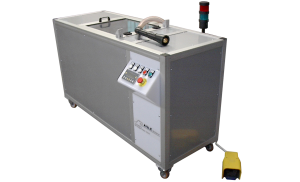
ESP1 electro-pneumatic flock distribution group for flocking internal areas, made of a dosing group and a spraying group.
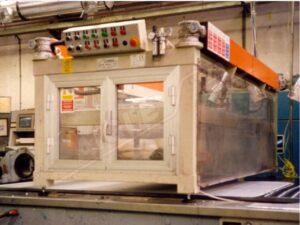
TC2/COMPL flocking unit for rotary screen printing machines: two hoppers with motorized brushes, 100 kV generator, suction pre-cleaning and brushing at the oven outlet.
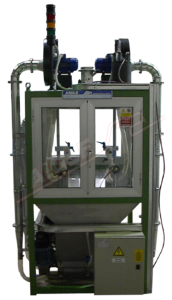
FR/ESP electropneumatic flocking machine for profiles with undercuts: a modular unit placed next to the hopper flocking machine, before pre-cleaning.
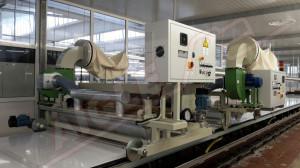
TDP glitter distribution unit for rotary printing: a hopper with an inverter-controlled dosing cylinder that spreads glitter evenly on the fabric.
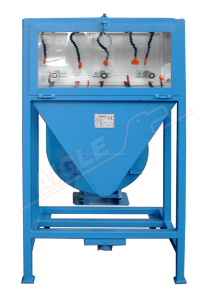
PRCP and Jet-Matic suction and pre-cleaning group, after the flocking machine: it pre-cleans the profile before the oven and limits flock dispersion.
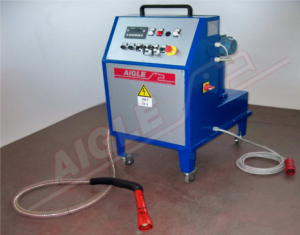
ESP1-B electro-pneumatic flock distributor: compact and easy to handle, for production and sampling, with dosing group and spraying group.
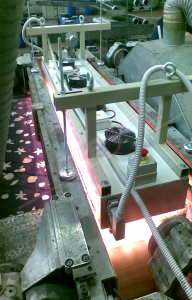
FIR/S infrared oven for pre-drying between printing heads, setting latex after coating or pre-heating PVC before embossing.
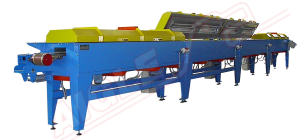
FAC12, FAC12/G, FIR/AC12 and FIR/AC12/G ovens for profiles: four 3-metre bays heated with electric or gas hot air, or with infrared and hot air.
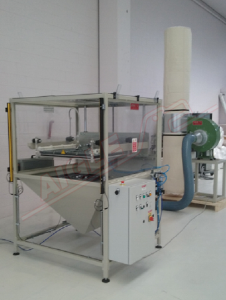
CTA/TO flocking cabinet for objects: sealed cabinet, hopper with brushes oscillating pneumatically over an electrostatic screen and adjustable hopper height.
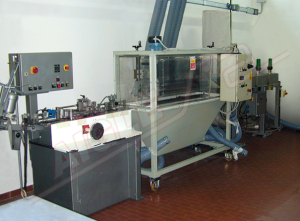
LFN ribbons flocking line: ribbon unwinder, flat screen printing machine, flocking machine with longitudinal hopper and flock recovery, electric oven and rewinder.
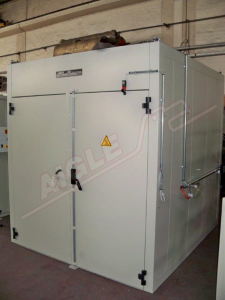
FA1 drying oven with forced convection: hot air recirculating around electric heaters, rock-wool insulation, swing doors and trolleys for the products.
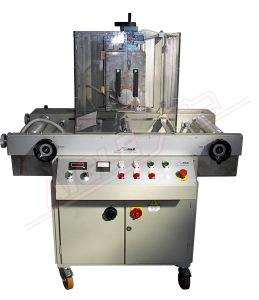
LFL laboratory flocking line: hopper with rotating brush, 0–50 kV electrostatic generator and repeatable passes that simulate a flocking machine with several hoppers.
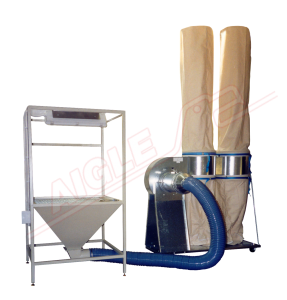
CA flock spraying/cleaning cabinet, open at the front: support net for the objects, flock recovery with collector, suction fan and filter bag.
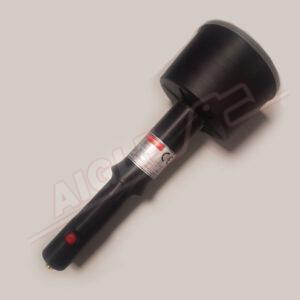
EASY FLOCK/N manual flocking device for samples and small batches, battery-powered (about 8 h) or fed by the GE-100-1 generator, for flat and concave surfaces.
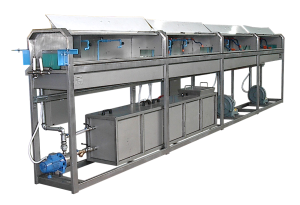
WCP6 cleaning and cooling unit for flocked profiles: nebulized water removes excess flock and cools the profile, then compressed-air cleaning and air drying.
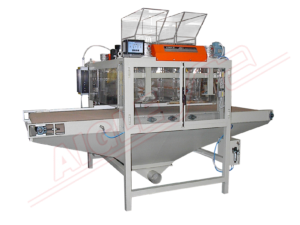
TT2 flocking machine for objects and flat surfaces: motorized conveyor belt with fiberglass net and two Plexiglas hoppers with rotating brushes.
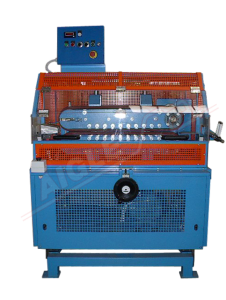
CTP800 caterpillar for profile lines: two opposed rubber-covered Poly V belts with constant pressure; the upper belt lifts automatically when the machine stops.
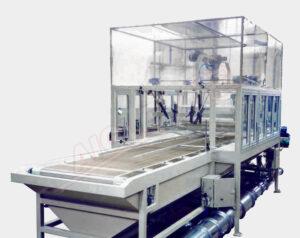
TTS flocking machine for car glove boxes and objects: sealed cabin against flock dispersion and variable-speed conveyor belt with feeding guides.
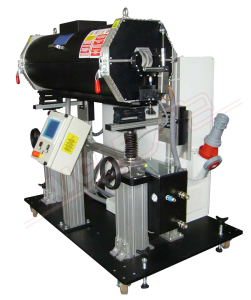
NIRV-101 NIR pre-vulcanization unit: six sections with two near-infrared lamps each, temperature set zone by zone via PLC, water-cooled.
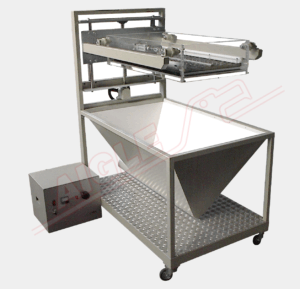
TO flocking machine for t-shirts, mounted on common carousel printers, with or without flock collector or suction unit.
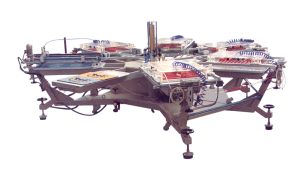
TO/S flocking machine for t-shirts and sheets on carousel printers: two or more units on the same carousel give multicolour flocking.
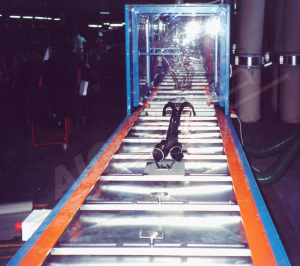
LFPD discontinuous flocking line for cut profiles, designed on the customer’s needs: profiles are placed on templates on a conveyor belt.
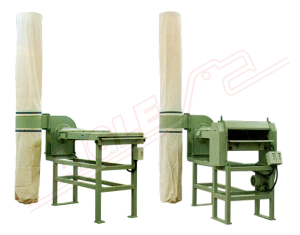
Cleaners for flocked sheets, panels and pre-cut garments: vibrating cleaners PFA and PM and rotating brush cleaner PFS, with suction fan and filter sleeves for flock recovery.
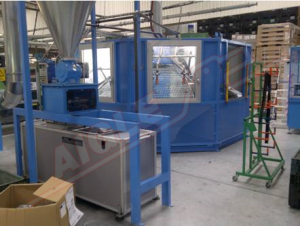
GFPD discontinuous flocking for car rubber profiles: it flocks one or more corners after the profile has been assembled or moulded.
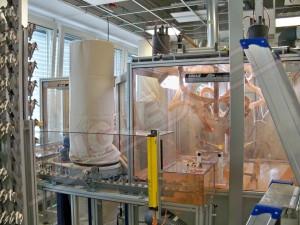
FDT system for flocking designs on three-dimensional objects: pad printing techniques for curved surfaces of different shapes, lower costs and abrasion resistance.
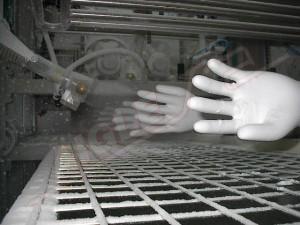
Flocking equipment for latex gloves: flock applied on the latex-dipped forms, with the latex acting as glue, so the glove is easier to put on and more comfortable.
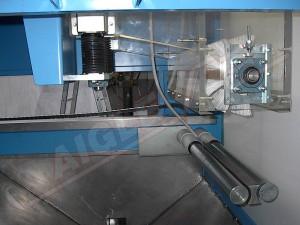
Flocking equipment for rubber sleeves: tubular sheaths that are flocked, vulcanized and cut into strips used as transmission belts for engines.
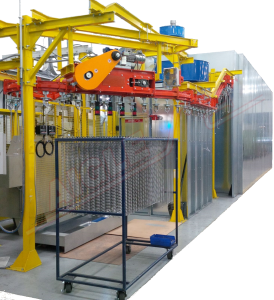
Flocking equipment for metal springs, used mainly in the automotive industry: the flocked springs go into the door-opening systems of cars.
Painting equipment for metal springs, used mainly in the automotive industry: the painted springs go into the door-opening systems of cars.
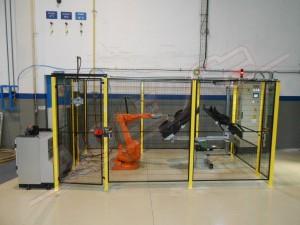
CF/R automatic flaming cabinet: a robot flames objects of different shapes on a rotating table, loading on one side while the other side is treated.
CP/R atmospheric plasma treatment cabin: enclosed cabin with safety guards, plasma unit and robot for surface treatment of objects.
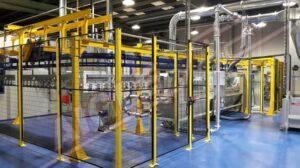
Flocking plants for cast-iron bell insulators: the insulator is flocked at the opening to avoid friction with the parts that touch it in use.

CA/A final cleaning unit for flocked objects: rotating bar with compressed-air nozzles, automatic doors, flock collection with filter and ionizing bar against static charges.
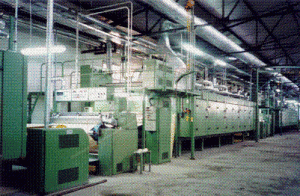
FOP/T drying oven with conveyor: recirculation fan, oil heat exchanger, blowing channels, air recovery channel and filter.
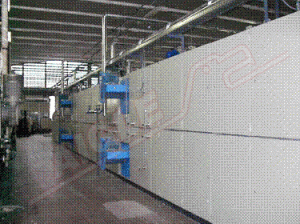
RAM/S stenter with double heating: different temperatures above and below the product, suited to latex-coated carpets whose needle-punched surface must be protected.
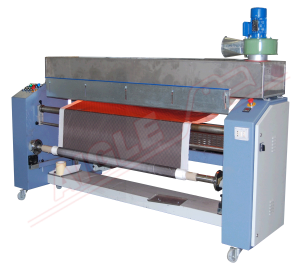
PLOTTER-HEAT oven for digital textile printing, at the outlet of the plotter: IR lamps synchronized with the belt, uniform drying and colours unaltered.
LSN sanding line with sanding belt system: unwinder, drawing group, belt sanding machine, brushing, rewinder and dust extraction; sanding against counter-cylinder or in air.
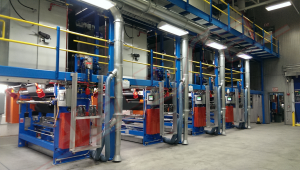
LST three-head printing line: only the outer shell of the printing cylinders is replaced, quick cylinder change and an oven that dries all inks, water-based too, at high speed.

Second-hand direct coating line with two heads for fashion and technical coated fabrics: one or two heads in one pass, or two independent lines.